

GX & ENVIRONMENTAL VALUE SUPPORT
We support the entire process of creating environmental value—from GHG reduction initiatives using Earth Vision, our core MRV platform, to converting verified reductions into carbon credits. By applying satellite data through MRV, we bring greater objectivity to on-the-ground activities and strengthen the credibility of carbon credits and reports.
CORE SERVICE 02
SIX STEPS
Six steps of GX & Environmental Value Support
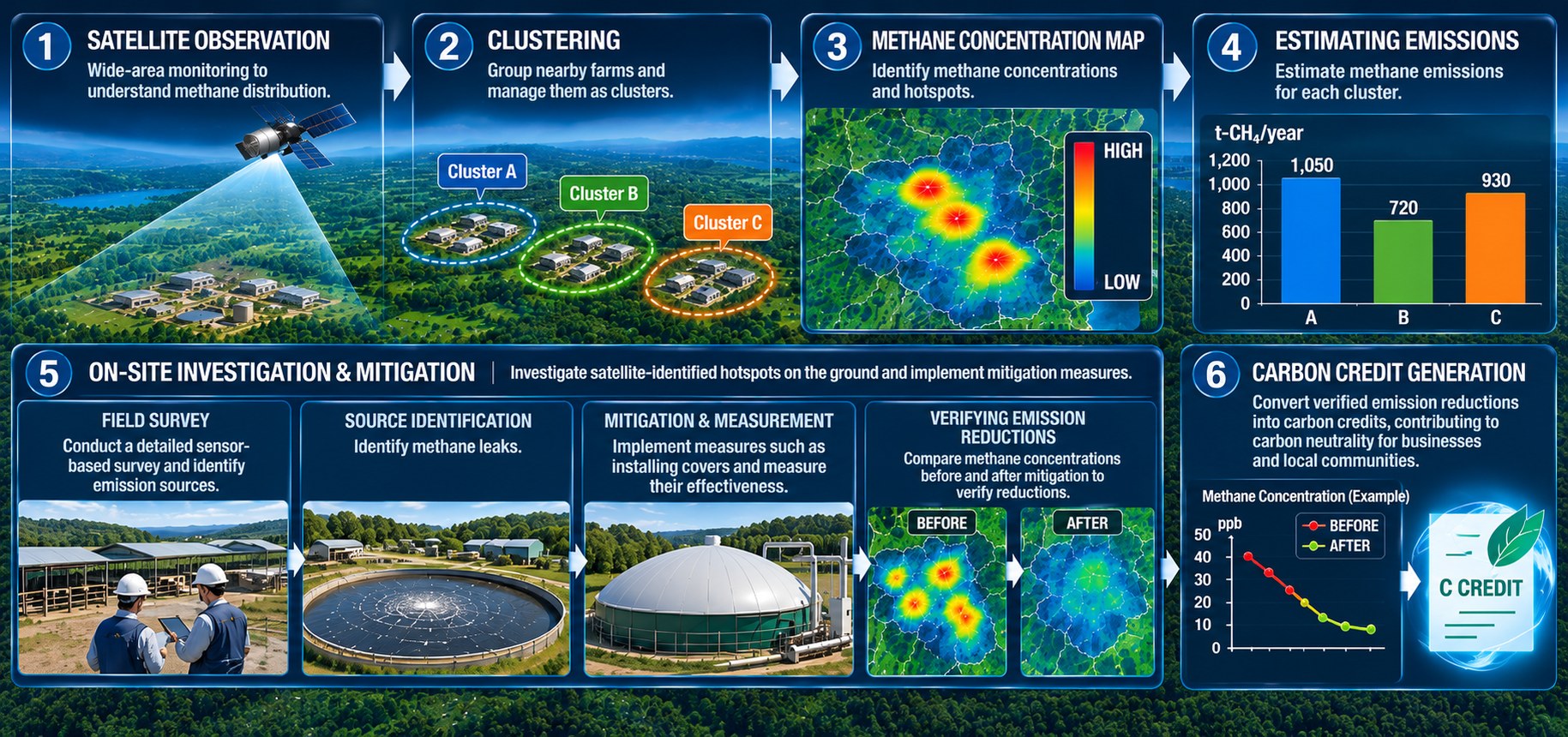
Using the livestock sector as an example, our environmental value support service follows these six steps.
-
 01
Satellite Observation
High-precision methane-monitoring satellites observe large areas and collect concentration data. We use these data to build a database of methane concentration patterns.
-
 02
Clustering
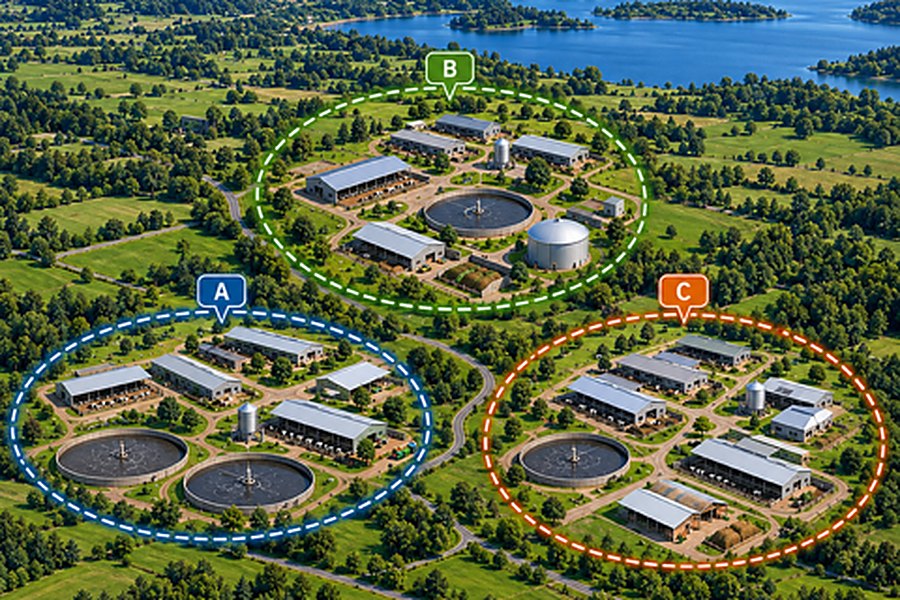
Based on the measurements, nearby farms are grouped into clusters to efficiently identify emission sources and establish baseline concentration levels across a region. This helps identify areas where GHG reduction efforts should be prioritised.
-
 03
Concentration Mapping
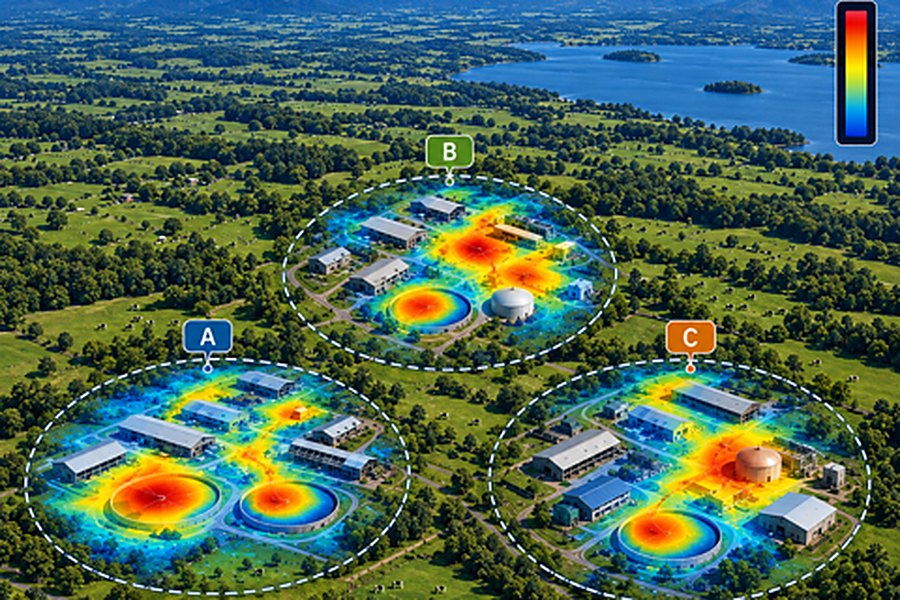
The identified areas are visualised in Earth Vision GIS, showing emission levels by cluster and highlighting where targeted mitigation measures are most needed.
-
 04
Fixed-Point Measurement
Guided by the analysis in Earth Vision, ground-based measurements are taken at selected locations. Where useful, these are supplemented by low-altitude measurements using drones or other unmanned aerial vehicles (UAVs) to identify hotspots with the highest GHG concentrations.
-
 05
Implementation of GHG Reductions
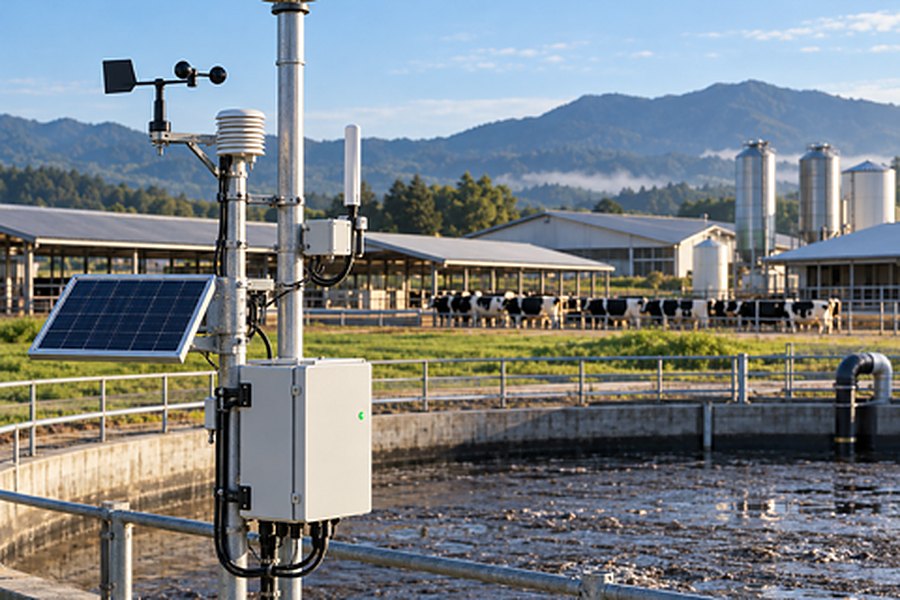
At identified hotspots, ground sensors, wind gauges, communications equipment and data systems are installed for continuous monitoring. Targeted GHG reduction measures, such as manure treatment, changes in animal feed and conversion to biofuel, are then implemented.
-
 06
Carbon Credit Generation
The achieved GHG reductions are quantified using measurement data and recognised methodologies. Once the reductions have been verified and certified by the relevant body, they can be issued as carbon credits. We support clients in registering and bringing these credits to domestic and international carbon markets.
WHY GBS
Why one provider across the chain
-
Connected Measurement and Mitigation
Satellite observations help identify hotspots across wide areas, guiding on-the-ground surveys and the implementation of targeted reduction measures. GBS supports the entire process, from wide-area monitoring to carbon credit generation.
-
Objective Verification Through MRV
MRV enables objective verification of the impact of on-the-ground measures by comparing conditions before and after implementation. As more measurement data is collected over time, the evidence becomes more robust and supports continuous monitoring.
-
Deployment aligned with policy design
Japan's GX-ETS framework, the growing focus on carbon neutrality in agriculture and fisheries, and the prospect of carbon pricing are all shaping the policy landscape. GBS aims to develop its services in line with these evolving trends.
SCOPE
The areas we cover
Any industry or site with potential for GHG reduction may fall within our scope. We are starting with agriculture, forestry and fisheries, and plan to expand into additional sectors over time.
-
GHG Reduction Through Methane Mitigation
GHGAccording to IPCC assessments, methane has approximately 28 times the global warming potential of carbon dioxide over a 100-year period and around 84 times over a 20-year period. GBS is initially focusing on methane because reducing these emissions can deliver significant climate benefits.
-
Agriculture and Livestock
DOMAINAgriculture and livestock are major sources of methane emissions in Japan, making this sector a key starting point for GBS's GHG reduction initiatives.
-
Green Carbon
CARBONCarbon absorbed and stored by forests and other terrestrial vegetation through photosynthesis. Methane can also be released by decomposing organic matter and livestock.
-
Blue Carbon
CARBONCarbon that is captured and stored by coastal and marine ecosystems, such as seagrass meadows and tidal wetlands. Its role in carbon credit programmes is expected to grow.
-
Teal Carbon
CARBONCarbon stored in freshwater ecosystems and inland wetlands. Rice paddies and wetlands can also be significant sources of methane.
-
Brown and Grey Carbon
CARBONCarbon associated with fossil fuels, including natural gas, oil and coal. In this context, methane emissions from natural gas are particularly relevant.

GHG Reductions Must Be Demonstrable, Not Merely Claimed.
The credibility of an environmental report or carbon credit depends on the evidence behind it. Field measurements, calculations based on nationally recognised methodologies and third-party verification are all important. MRV supported by measurements from low Earth orbit satellites and mid-altitude platforms can further strengthen the scientific basis and objectivity of assessments, while helping address workforce constraints.
MARKET TREND
Market trends
Following the adoption of Japan's Global Warming Countermeasures Plan in 2025, efforts to achieve net zero by 2050 are gaining momentum. The development of GHG reduction technologies and complementary mechanisms, such as carbon credits, is part of this broader trend.
-
Revised GX Promotion Act and GX-ETS
Japan's GX-ETS framework is introducing requirements for emissions reduction and emissions trading for covered businesses. Companies subject to the scheme must comply with the applicable participation and reporting requirements. Even businesses outside its scope may increasingly face requests from business partners for product carbon footprints (PCFs), emissions-intensity data and Scope 3 reduction plans. These developments are likely to increase the importance of GHG reduction across supply chains.
-
MAFF's Global Warming Countermeasures Plan
Updated in line with the government's Global Warming Countermeasures Plan, the Ministry of Agriculture, Forestry and Fisheries (MAFF) plan sets GHG reduction targets across agriculture, food, forestry and fisheries. Relevant measures include reducing methane emissions from rice cultivation, extending mid-season drainage, reducing nitrous oxide (N2O) emissions from fertilisers and livestock, and increasing carbon storage in agricultural soils. Carbon credit schemes such as J-Credit can help finance on-the-ground GHG reduction initiatives.
-
Support for GHG Reduction Initiatives
Carbon pricing, higher fossil-fuel levies and the adoption of lower-carbon fuels such as e-fuels and sustainable aviation fuel (SAF) can all affect the cost of reducing emissions. Business models that generate revenue from verified reductions — through carbon credits, regional decarbonisation grants, GX technology support and other public programmes — can help make GX initiatives more financially sustainable.
-
Government Support for Satellite Data Applications
The European Commission has noted that, although Earth observation data is widely available, services that translate it into regulatory compliance, risk assessments, key performance indicators (KPIs) and actionable decisions remain limited.
Japan also identifies space as one of its 17 growth strategy fields. Under the Basic Plan on Space Policy, the government aims to promote remote-sensing solutions by encouraging public- and private-sector demand in Japan and overseas. Through initiatives including the Space Strategy Fund, it is also seeking to expand the use of commercial satellite data and grow the domestic space market.
The public-private investment roadmap also sets targets for more than 30 real-world deployments of satellite communications, Earth observation and positioning-data services in Japan and overseas by the early 2030s. It also aims to expand demand captured by Japanese companies across satellite manufacturing, operations and data applications by 2040.
Sources: Public materials from METI, the Agency for Natural Resources and Energy, MAFF, the Ministry of the Environment, the Cabinet Office, NEDO, JAXA, the European Union and other organisations.

CONTACT
Put Satellite Data to Work for Your Business
Contact us to discuss satellite data applications, GX and decarbonisation management, J-Credit projects or public funding.
Our specialists will recommend an approach tailored to your needs.